Articles
Trends in Alternative Work Arrangements
By
Daryl Johnson, TkMC, (formerly Turnkey Management Consulting)
&
Gail Evans, The Wynford Group
Featured In HR Professional Magazine
October/November 2002
As in other areas of Human Resource Management, flexibility has increasingly become an important factor in determining effective work arrangements that suit the needs of specific employment sectors and serve as attraction and retention strategies for employers. To accommodate employee needs, increasing numbers of organizations have implemented the following alternative work arrangement strategies:
- Job-Sharing
- Flex-time
- Compressed Work Weeks
- Telecommuting
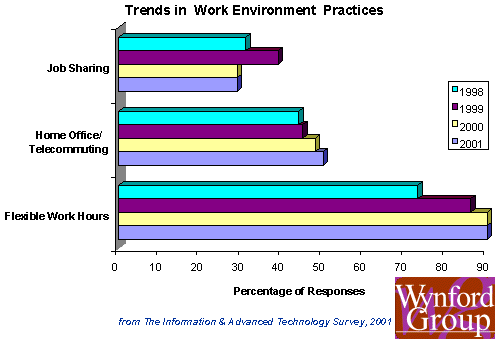
The following chart displays trends in these practices over the last 4 years in Alberta:
Demographically driven changes are affecting workplaces, in particular, many Baby Boomers are approaching retirement age. Some of the unique expectations for retirement that will emerge include many Boomers remaining in the workforce during their retirement years, whether it be to start their own business, work full-time at a new job/career, or work part-time/flex-time hours for the sake of interest and enjoyment. Boomers will experience retirement dramatically different from a generation ago, as evidenced by fewer Boomers moving to new geographic locations, their tendency to have a lesser concern about making ends meet after retirement, and expectations of minimal disruption to their current lifestyle.
Employee groups’ aged 45 and older account for close to 35% of the working population. Specifically, over the next decade a substantial number will be eligible for retirement leaving insufficient numbers of younger workers to fill these vacancies. To add to this problem, there are specific skills and knowledge held by some of these “senior employees” that are not easily or quickly replicated. For example, in the energy sector in Alberta, there has been an ongoing shortage of experienced Reservoir and Exploitation Engineers, which has been compounded by a reduction in emphasis on in-house training & development for these specific skills.
In response to these conditions, there are several emerging strategies that are gaining prominence.
- Phased-in Retirement
- Mentoring
- Flex Strategies
1. Phased-in Retirement
From a workforce talent management perspective, the use of this strategy is beneficial to both employers and employees for the following reasons:
- Increased flexibility for employers in managing peak work periods, temporary and special projects.
- Continuing access to key skills & knowledge.
- Flexibility in supporting lifestyle considerations and easing into retirement activities for senior employees.
This strategy also has some implications for pensions and benefits, which suggest that employers examine of the potential use of different pension plan strategies to provide the most useful benefits to employees, yet realize cost-effective results for employers. This also supports the use of flexible total compensation strategies. For example, a Calgary-based energy producer is developing a Flexible Total Compensation Plan which includes cafeteria choices for cash, benefits, retirement, vacation etc.
2. Mentoring
In the present knowledge economy, many industries are increasingly dependent upon continuous learning and the development of specific skills and competencies. Combined with the projected skill shortages and demographic challenges, mentoring is viewed as an effective method of key knowledge transfer. This can be accomplished by:
Internal Mentors/Coaches:
- In knowledge-based organizations senior employees are increasingly providing on going mentoring and coaching for developing employees, so that they can gain the industry or company specific knowledge.
- For example: Research & Development companies use senior technical gurus to pass on critical knowledge to developing employees. Technology solutions companies such as LGS have effectively employed career coaches for several years.
External Mentors/Coaches:
- External executive coaches are becoming increasingly common for senior management employees, and can provide a different and objective perspective.
- External mentor/consultants can also provide a broad range of industry knowledge and experience to more junior employees to support the development of professional skills and can almost be viewed as an “apprenticeship” strategy.
- Professional Associations and academic institutions can also play a mentorship role. For example. The Human Resource Association of Calgary and the University of Alberta and Grant MacEwan College in Edmonton have had a Mentorship or Student Mentorship programs for several years where senior HR practitioners volunteer to mentor developing HR professionals.
3. Flex Strategies
The use of the “portable office” where laptop computers, PDA’s, email and other
business tools can be plugged in at home, client site or the cottage as easily as
the office has increased the flexibility of employees to work in many different
environments without losing significant productivity.
Office Hotels: An increasing number of professional services firms have offices
that employees can book for the time they need when they are in a particular location.
IBM is a good example of the use of this strategy.
As employees work more independently to produce results, the use of flexible hours
has become more common, which allows employees to plan their own work time and work
balance. For example, Westjet has recently implemented flextime for some groups
of employees, which identifies a specific number of hours of work per week, with
the employee determining the scheduling of these hours, with the intention of providing
greater work/life balance.
In conclusion there is increasing pressure on employers to develop and use alternative
work strategies that fit their particular business and employee needs, as well as
making the most effective use of their Human Capital. A key component of success
appears to be providing the greatest amount of work flexibility that their organizations
can tolerate.